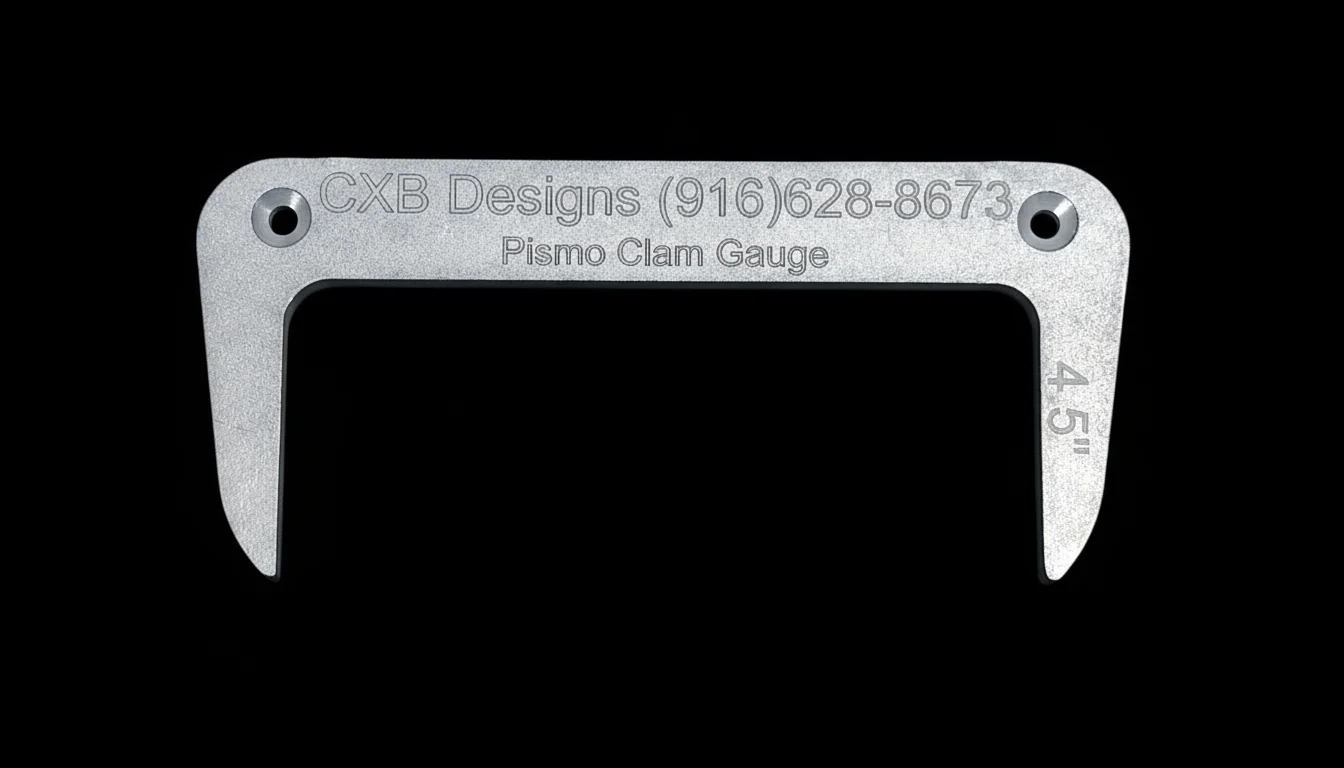
A complete Pismo clamming kit is shorter than most newcomers expect. The legal minimum is a fishing license, a fixed measuring gauge, and a personal container for the harvest. Practical clamming adds a clam fork (the right one matters), waders or boots, a catch bag for keeping clams in while still working the surf, and a few small accessories. This page covers each item, what to look for, and where to buy — including the equipment manufactured by the publisher.
The Minimum Kit
Before any product recommendations, the legal and practical minimum:
- A California sport fishing license — required for everyone 16 and older. Not a product; available from CDFW or any sporting goods retailer.
- A fixed-dimension measuring gauge with a 4.5-inch opening — required by California law. A ruler or caliper does not satisfy the rule; the gauge must be a fixed, non-adjustable dimension.
- A personal container for harvested clams. A bucket, a mesh bag, or any rigid vessel works. California law requires that each clammer carry a separate container; commingled harvests violate the regulations.
Everything else on this page is practical equipment that makes clamming easier or more comfortable, but is not legally required.
The Pismo Clam Gauge
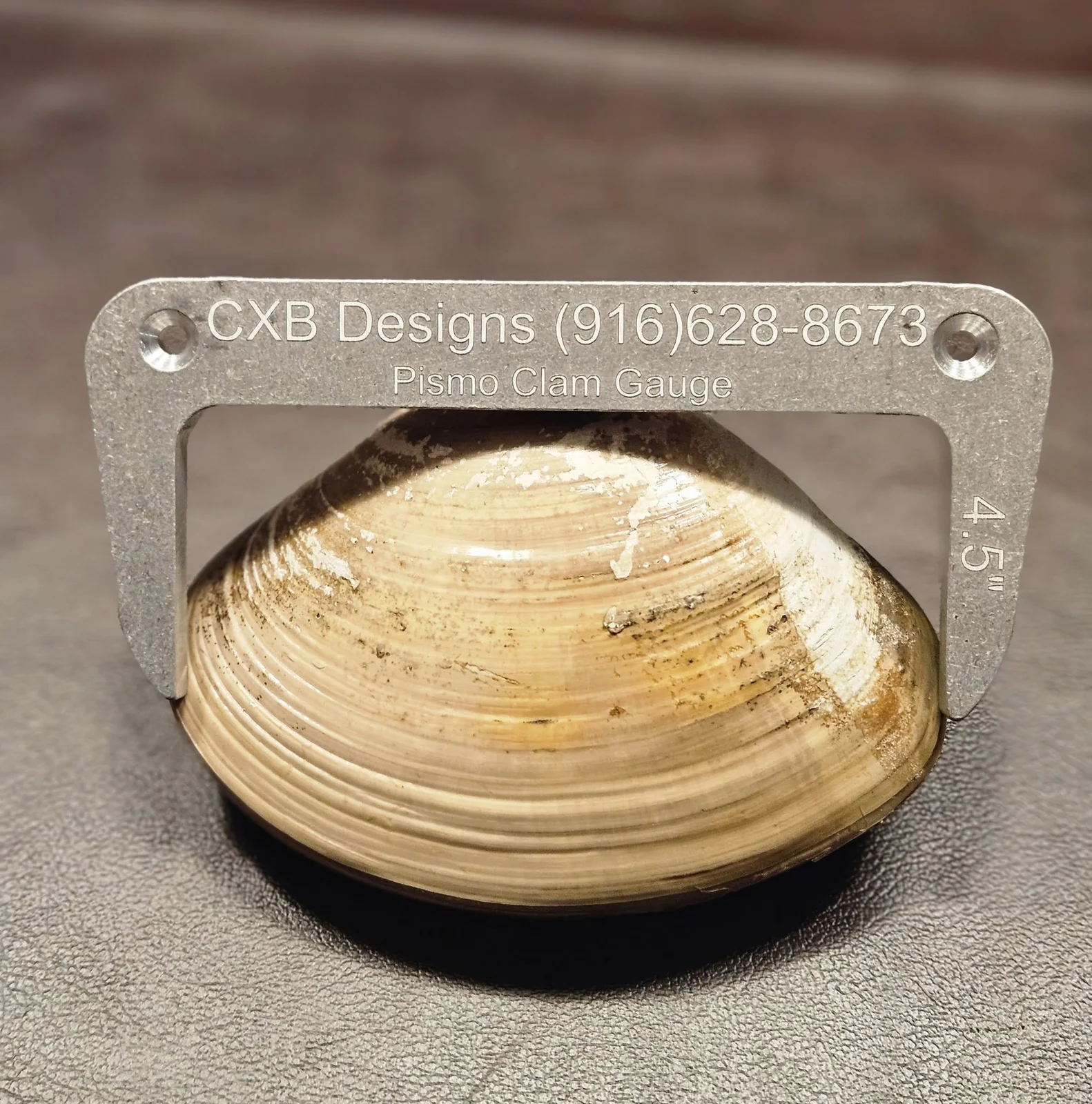
The gauge is the single legally-required item on the beach beyond the fishing license itself. Its function is simple: every clam dug must be measured, and any clam smaller than 4.5 inches in greatest shell diameter must be reburied where found. The gauge is the fixed-dimension reference that makes that measurement legal and unambiguous.
What makes a gauge good is what it lacks: it must not flex, must not corrode in saltwater, and must measure exactly 4.5 inches without ambiguity. A gauge that sits in a five-gallon bucket of wet sand for years and still reads 4.5" is doing its job. A gauge that bends or rusts after a season fails its job and exposes the user to a citation.
The publisher's recommendation
The publisher of this site, CXB-Designs, manufactures a Pismo Clam Gauge. The reasons it is recommended:
- Construction. Laser-cut from quarter-inch 6061 aluminum and CNC-machined to a precise 4.5-inch opening. Will not flex, will not bend, will not rust in saltwater.
- Mounting. The back side has a curved channel CNC-machined to fit the handle of a standard clam fork. The gauge clamps to the fork handle and stays there — no lanyard, no fumbling for it in a pocket. To the publisher's knowledge, this is the only fork-mountable gauge available by mail order. There is one other fork-mountable gauge produced locally and sold only in Grover Beach; nothing online.
- Design lineage. Patterned after the gauges that California clammers carried in the 1950s through 1990s, when the recreational fishery was at its peak. The shape works.
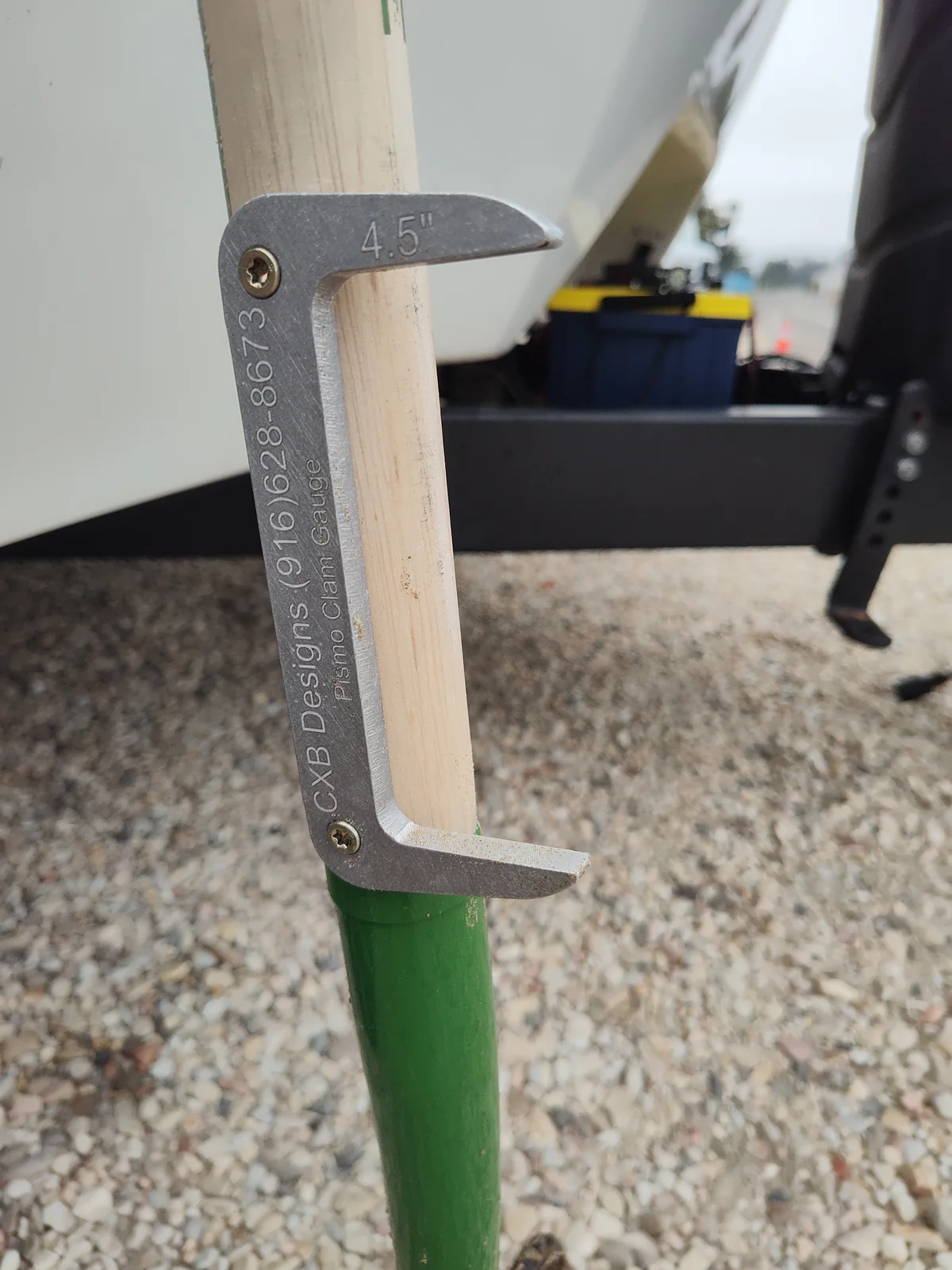
Laser-cut quarter-inch aluminum, CNC-machined opening, fork-mountable.
Other gauges on the market are also valid — the legal requirement is a fixed 4.5-inch opening, not a particular brand. Aluminum and stainless options are available from various small fabricators. What the publisher cautions against is any gauge that flexes (some plastic and thin-aluminum gauges do), and any improvised tool that lacks a fixed dimension. A wildlife officer who finds an undersized clam in a bucket and a flexible measuring device on the beach is unlikely to accept that the device measured the clam correctly.
The Clam Fork
The fork is the work tool. The How to Clam page covers the technique in detail; the short version is that a Pismo clammer probes the wet sand with the fork tines, listens for the ringing thud of metal striking shell, then drives the fork in deep and levers the clam up. The right fork makes this work; the wrong fork wastes time and energy.
What a clam fork needs:
- Five or six narrow tines, each round in cross-section and tapered to a fine point. Wide flat tines (potato fork, hay fork) drag too much sand and miss the clam.
- Tine spacing of roughly 1.25 to 1.5 inches. Wider spacing lets clams slip between tines unfelt; narrower spacing turns the fork into a shovel.
- Tine length of about 12 inches. Long enough to dig under the clam and pry it loose; short enough that the leverage geometry works.
- A D-handle. Two-handed leverage during the lift is what brings the clam up. A straight-shaft handle without the cross-bar makes the lever motion harder.
- A wooden shaft rather than fiberglass or steel. Wood absorbs the vibration when the tines strike a rock or shell; metal shafts transmit it straight to the wrists.
The publisher's recommendation
The John Deere clam fork carried by Ace Hardware (SKU 7005562) is the only fork currently in retail distribution that meets all of the criteria above. Its tine geometry, spacing, length, and handle design are well-suited to Pismo clamming. The publisher works this fork. To the publisher's knowledge, no comparable fork is available from Amazon, Walmart, or other online retailers at this writing — most "clam forks" sold online are repackaged garden forks with the wrong tine geometry.
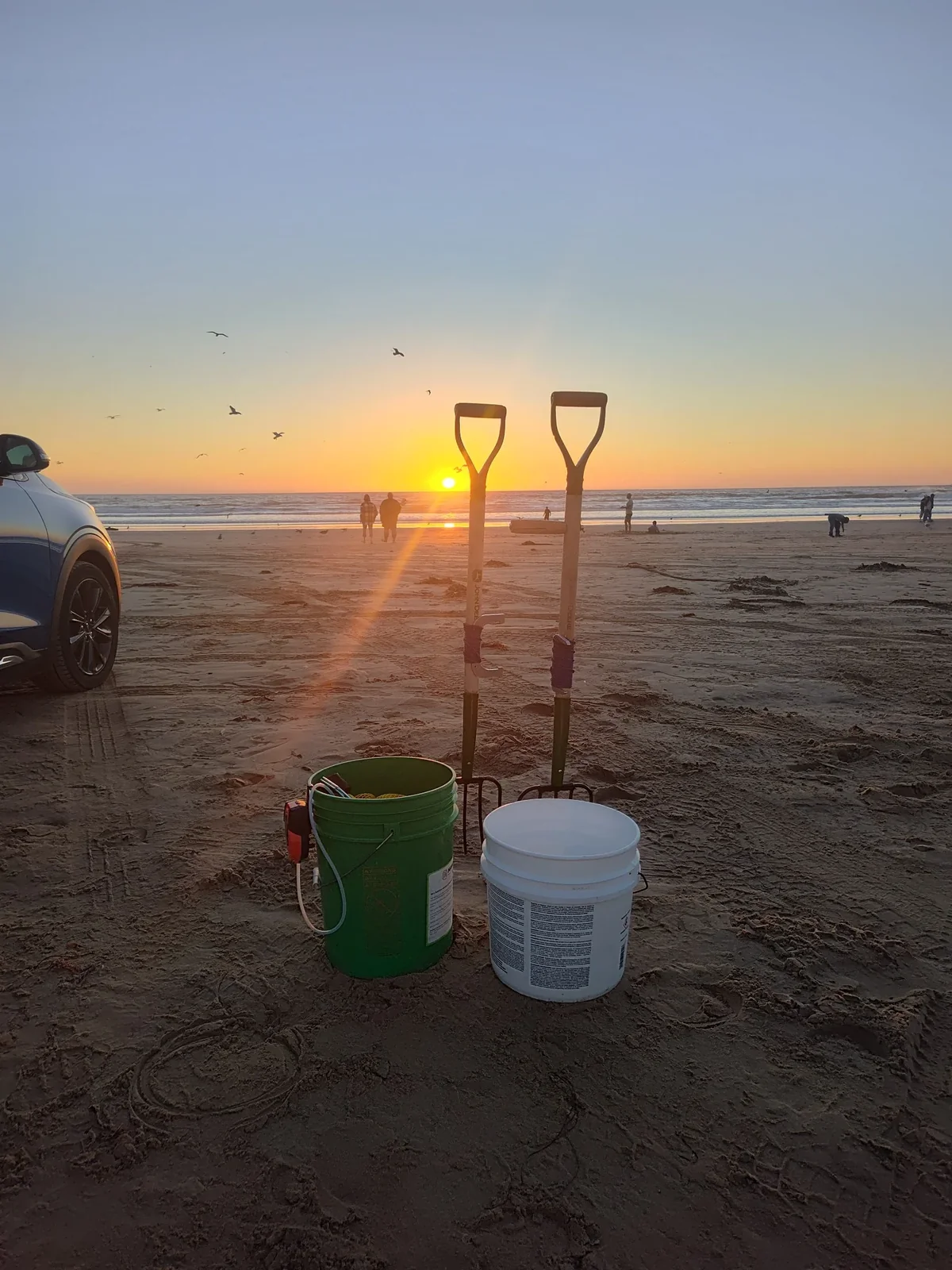
Five-tined, D-handle, wooden shaft. Available at Ace Hardware (in-store and online); not currently stocked by major online retailers.
The fork is also the most likely piece of equipment to outlast the clammer. A well-made wooden-handled fork properly rinsed after each session will work for decades. It is worth buying once and buying the right one.
Mesh Catch Bag
The catch bag holds legal-size clams while the clammer keeps working. A mesh bag is preferable to a bucket for working in the surf for two reasons: water flows through the mesh, keeping the clams oxygenated and alive, and the bag tethers to the wader belt or the fork shaft so the clammer's hands stay free. A bucket sitting on dry sand fills with hot air and stresses the clams; a bucket dragged into the surf fills with water and gets heavy fast.
What a catch bag needs:
- Knotted nylon or polyester mesh, not woven cloth. Mesh allows water flow.
- A drawstring or spring-loaded closure so clams cannot escape during the walk back up the beach.
- A clip or carabiner for tethering to a belt or fork.
- Capacity for at least 10 clams — the legal daily limit per harvester — with comfortable room. Pismo clams are heavy; a bag of ten legal-size clams weighs roughly five to seven pounds.
Knotted polyester mesh, hoop-frame opening, drawstring closure. The yellow color visible in the surf helps the clammer keep track of the bag in the wash.
For carrying the bag without tying it to the fork, a wader belt with a D-ring or carabiner is the cleanest solution. The bag clips to the belt and rides on the hip, keeping it out of the way during digging.
Heavy nylon webbing with quick-release buckle and D-rings for clipping the catch bag, gauge tether, or other small gear. Wears outside the waders or over a fishing vest.
CXB-Designs has a mesh catch bag in development. When it ships, it will be referenced here. Until then, the recommendation above is the publisher's preferred current option.
Chest Waders
Chest waders are not legally required, but they transform the clamming experience. The productive band on a typical low tide runs from below the high-tide mark out to roughly thigh or waist depth on the deeper end. Working that band in shorts means standing in 55-degree Pacific water for several hours; working it in chest waders means staying warm and dry. The publisher uses waders on every session.
What waders need for Pismo clamming:
- Bootfoot construction. Bootfoot waders integrate the boots into the wader, sealing out sand. Stockingfoot waders (which require separate wading boots) admit sand at the cuff line, and sand inside waders is miserable.
- Neoprene rather than nylon for the cold months. The Pacific off Pismo runs 52–58°F most of the year. Neoprene insulates; thin nylon waders do not.
- A high back design for the deeper end of the productive band. Some sessions involve standing in water up to the chest while a wave passes; a low-back wader fills.
- Reinforced knees. Clammers sometimes kneel on the wet sand to extract a clam; the wader has to take the abuse.
- Adjustable suspenders with quick-release buckles so the wader can be shed quickly if needed.
The publisher recommends the Frogg Toggs Amphib line. Frogg Toggs has been making affordable, well-constructed waders for decades; their Amphib model is the one the publisher wears on Pismo Beach. Three options below cover the typical use cases.
3.5mm neoprene upper with a high-back design, reinforced knees, and 200-gram Thinsulate-insulated rubber boots. The publisher's wader of choice for winter clamming, when surf temperatures drop into the low 50s.
The same Amphib construction in a women-specific cut: shorter inseam, narrower hips, smaller boot sizing. 3.5mm neoprene with 200-gram Thinsulate boots and reinforced knees.
2-ply rubberized polyester upper, vulcanized seams, steel-shanked rubber boots. Less insulation than the neoprene Amphib model; significantly less expensive. Suitable for warmer months or for clammers who want to try the activity before committing to higher-end gear.
Sizing note: bootfoot waders fit small in the foot. Order a half-size up from your normal shoe size, especially if planning to wear thick wool socks underneath in cold months.
Bucket
A standard five-gallon plastic bucket holds the clammer's gear at the waterline, transports clams from the beach to the vehicle, and acts as a personal container under the legal commingling rule. Any sturdy bucket works; a Home Depot Homer bucket, a paint store five-gallon, or any equivalent.
What helps:
- A handle that doesn't cut into the hand when the bucket is full of clams and seawater. A foam grip or a spare bicycle inner-tube wrap helps. Hardware stores sell aftermarket bucket handles for a few dollars.
- A lid is optional but useful for the drive home if the clams will be transported live. A lid keeps the clams from spilling and the seawater from sloshing.
- One bucket per clammer. California regulations require each harvester to keep a separate container; commingling is a violation.
The publisher does not recommend a specific bucket on this page because any sturdy bucket works equivalently. Buy local at any hardware store.
Optional and Nice-to-Have Equipment
None of the items below is required, but each makes a clamming session more comfortable or productive.
A small towel or rinse bottle
For wiping sand off the gauge before measuring, or rinsing a clam to read the growth rings. Any towel; any squeeze bottle of fresh water.
Sun protection
The Pismo coast is foggy more often than sunny, but sun off the wet sand on a clear day is intense. A wide-brim hat and sunscreen on the back of the neck make a long session sustainable.
Layers
The marine layer can drop the air temperature by 10 to 15 degrees within a quarter-hour. Even in summer, a fleece or wool layer under the wader top makes the difference between comfort and shivering.
A waterproof phone pouch
For checking the tide app, photographing a notable clam, or calling for help. Phones in unprotected pockets and chest waders that occasionally take in a wave are not a happy combination.
Knee pads
Some clammers kneel on the wet sand for the lever-and-extract motion. Soft foam knee pads worn under the waders save the knees over a long session.
What Not to Bring
A few items often appear on lists of "clamming equipment" online that are not appropriate for Pismo clamming.
Hydraulic pumps and blowers
Illegal in California for taking clams. CCR Title 14 § 29.20 prohibits the use of hydraulic equipment, suction devices, or any pumping mechanism for clam harvest.
Shovels
A shovel will technically work but it damages the bivalves more than a fork does. Pismo clamming is regulated to require careful release of undersized animals, and a shovel's wide blade is more likely to crack shells. The fork is the right tool.
Rakes
Some clamming on the East Coast uses bull rakes; this is for different species in different environments. A rake on Pismo Beach will not find Pismo clams reliably.
The Complete Kit, Listed
For quick reference, the full Pismo clamming kit assembled from this page:
- California sport fishing license (16 and older) — CDFW
- 4.5-inch fixed gauge — CXB-Designs Pismo Clam Gauge (also on Amazon)
- Clam fork — John Deere clam fork at Ace Hardware
- Mesh catch bag — drawstring mesh fishing bag on Amazon
- Utility belt for the catch bag — adjustable wader belt on Amazon
- Chest waders — Frogg Toggs Amphib (insulated, men's), women's insulated, or Cascades budget
- Five-gallon bucket (one per clammer) — any hardware store
- Optional: towel, rinse bottle, sun protection, layers, waterproof phone pouch, knee pads
Total invested cost ranges from roughly $150 (basic uninsulated waders, gauge, fork, bucket) to $300 (insulated waders, complete optional kit). The fork and gauge are one-time purchases that last decades.
Once the kit is assembled, the next steps are the Regulations for what the law requires of the harvester, the Tide Almanac for picking a clammable low tide, and How to Clam for the technique of finding and extracting clams on the beach.